


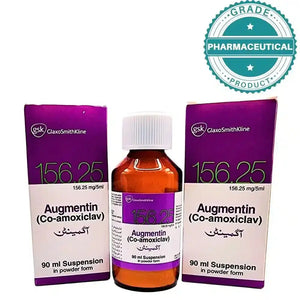

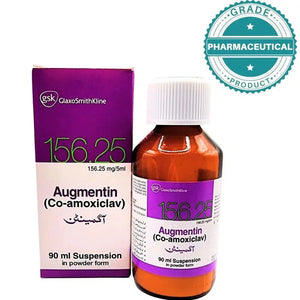
Augmentin Syrup 156.25mg/5ml 90ml — Co-Amoxiclav Paediatric
Augmentin Syrup 156.25mg per 5ml in a 90ml bottle is a prescription-only paediatric antibiotic combining amoxicillin with clavulanic acid (co-amoxiclav). It is prescribed by doctors for bacterial infections such as ear, sinus, throat, lower respiratory, urinary tract and certain skin or dental infections. The dry powder is reconstituted with cooled boiled water at the pharmacy or at home as directed, then refrigerated and used within the period stated on the carton.

Pay in 3 Installments of
Rs.
141


Augmentin Syrup 156.25mg/5ml 90ml — Co-amoxiclav Paediatric
Description
Augmentin (Co-amoxiclav) 156.25 mg/5 ml Suspension Detailed Information
Introduction
Augmentin, known generically as Co-amoxiclav, is a medication used to treat a wide range of bacterial infections. It combines two active ingredients: amoxicillin and clavulanic acid. This article provides comprehensive information about Augmentin, its composition, clinical
particulars, dosage, contraindications, and more
Composition
Augmentin is available in various forms, including tablets and suspension. Here's a breakdown of its composition:
Augmentin 375 mg Tablets:
Contains 250 mg amoxicillin (as amoxicillin trihydrate U.S.P) and 125 mg clavulanic acid (as the potassium salt B.P)
Augmentin 625 mg Tablets:
Contains 500 mg amoxicillin (as amoxicillin trihydrate U.S.P) and 125 mg clavulanic acid (as the potassium salt B.P)
Augmentin 1 g Tablets:
Contains 875 mg amoxicillin (as amoxicillin trihydrate U.S.P) and 125 mg clavulanic acid (as the potassium salt B.P)
Augmentin Suspension 156.25 mg/5 mL (when reconstituted):
Contains 125 mg amoxicillin (as amoxicillin trihydrate U.S.P) and 31.25 mg clavulanic acid (as the potassium salt B.P) per
5 ml
Clinical Particulars
Augmentin is a broad-spectrum antibiotic effective against a wide range of bacterial pathogens. It is commonly used to treat infections in the upper respiratory tract, lower respiratory tract, dental infections, genitourinary tract, skin and soft tissue, bone and joint, and other infections
Indications
Augmentin is prescribed for various conditions, including:
- Upper respiratory tract infections (e.g., tonsillitis, sinusitis, otitis media)
- Lower respiratory tract infections (e.g., bronchopneumonia)
- Dental infections (e.g., dentoalveolar abscess)
- Genitourinary tract infections (e.g., cystitis, pyelonephritis)
- Skin and soft tissue infections (e.g., cellulitis, abscesses)
- Bone and joint infections (e.g., osteomyelitis)
- Other infections (e.g., intraabdominal sepsis)
Dosage and Administration
The recommended dosage of Augmentin depends on the severity of the infection and the patient's age:
Adults and Children over 12 years:
- Mild to moderate infections: One Augmentin 375 mg tablet every 8 hours or one 625 mg tablet every 12 hours
- Severe infections: One Augmentin 1 g tablet every 12 hours or one 625 mg tablet every 8 hours
Children (2 years and over):
- The dosage varies based on the child's weight and the severity of the infection. Consult a healthcare provider for appropriate dosing
- Augmentin can be taken with or without food, but it's recommended to take it at the start of a meal to minimize gastrointestinal discomfort
Contraindications
Augmentin should not be used in individuals with a history of hypersensitivity to beta lactam antibiotics, penicillin, cephalosporins, or any of its components. It's also contraindicated in patients with a history of Augmentin associated jaundice/hepatic dysfunction
Warnings and Precautions
- Hypersensitivity: This syrup should be used with caution in individuals with a history of
penicillin hypersensitivity. Discontinue treatment if you experience hypersensitivity reactions as serious allergic reactions may occur. - Gastrointestinal Effects: Diarrhea may occur during or after antibiotic use, and treatment
should be discontinued if significant diarrhea occurs - Liver Function: Use this cautiously in patients showing signs of liver dysfunction, and regularly monitor their liver function.
- Renal Impairment: Dosage adjustments are necessary for patients with renal impairment
Adverse Reactions
Syrup may cause various adverse reactions, including gastrointestinal symptoms, skin rash, headache, and, rarely, serious allergic reactions. If any adverse reactions occur, it's important to seek medical attention
Storage
Store this syrup in a dry place, shield it from moisture, and avoid freezing it. After reconstituting, keep the suspension in a refrigerator and use it within 7 days.
Conclusion
Augmentin is a widely used antibiotic effective against a range of bacterial infections. Use it cautiously and be mindful of potential side effects and contraindications, although it's generally safe and well-tolerated by patients. Always follow the guidance of a healthcare provider when taking syrup
Usage & Benefits
Broad-spectrum co-amoxiclav antibiotic suitable for many paediatric bacterial infections.
Liquid suspension makes dosing easier for children who cannot swallow tablets.
Clavulanic acid component helps cover certain bacteria that are resistant to amoxicillin alone.
Measured by doctor according to the child’s weight and condition.
Provided as a dry powder that stays stable until reconstituted with water.
Produced by GlaxoSmithKline (GSK), an established pharmaceutical manufacturer.
How To Use
Use only on the advice of a qualified doctor; this is a prescription antibiotic, not for self-medication.
Reconstitution: add cooled boiled water in two portions up to the mark on the bottle, shaking well after each addition until a uniform suspension forms.
Storage after mixing: keep in the refrigerator (do not freeze) and use within the period stated on the carton, usually 7 days.
Shake the bottle well before every dose.
Measure each dose with the supplied syringe or measuring cup — do not use a household spoon.
Give the doses at the times your doctor advises and complete the full course even if your child feels better; stop and seek medical advice if a rash, severe diarrhoea or signs of allergy occur.
FAQs
What is Augmentin Syrup used for?
It is a prescription antibiotic used to treat various bacterial infections, including respiratory, ear, sinus, urinary tract, skin and dental infections in children, as decided by the doctor.
How is the syrup prepared?
The pharmacist or carer reconstitutes the dry powder with cooled boiled water up to the marked line, shaking well between additions until a smooth suspension forms.
How is it stored after mixing?
Keep the reconstituted suspension in the refrigerator and use it within the period stated on the carton, usually 7 days. Do not freeze.
Can my child stop the syrup once they feel better?
No. Complete the full course as prescribed even if symptoms improve early, to reduce the risk of relapse and antibiotic resistance.
Who should not take Augmentin?
People with a known penicillin or beta-lactam allergy, or significant liver problems linked to previous co-amoxiclav use, should avoid it. Tell the doctor about all allergies and medical conditions before starting.
Dermatologist Recommended


Healer's Pharma Minoxidil 5% + Finasteride 0.25% Hair Regrowth Spray

0.25% Finasteride Topical Hair Loss Spray by Healer's Pharma


