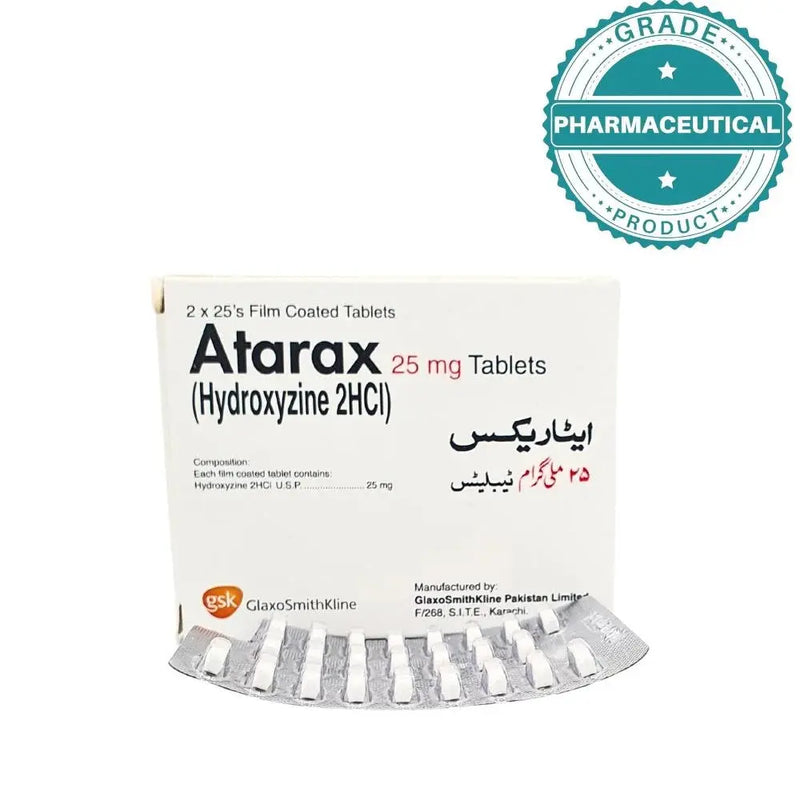
ATARAX TABLETS (HYDROXYZINE 2HCI) 25mg PACK OF 50 FILM COATED TABLETS

Pay in 3 Installments of
Rs.
46


 JazzCash
 easypaisa
 NayaPay


 Bank transfer
Cash on Delivery
Bank transfer
Cash on Delivery
Description
ATARAX TABLETS (HYDROXYZINE 2HCI) 25mg PACK OF 50 FILM COATED TABLETS: Comprehensive Drug Information
Active Ingredient: Hydroxyzine dihydrochloride Forms: Film Coated Tablets / Syrup
Indications:
- Atarax is a medication used for the treatment of the following conditions:
- Symptomatic relief of anxiety in adults: Atarax can provide relief for anxiety symptoms in adults
- Symptomatic relief of pruritus: It is effective in relieving itching associated with various conditions
- Atarax serves as a premedication option before surgical procedures.
Dosage and Administration:
Adults: The maximum daily dose for adults and children over 40 kg is 100 mg. For anxiety, a typical
dosage is 50 mg per day, divided into 3 separate administrations. In more severe cases, doses of up to 100 mg per day may be used. For pruritus, the starting dose is 25 mg at night, with adjustments up to 25 mg three or four
times daily. For premedication before surgery, 50 to 200 mg/day can be administered in 1 or 2 administrations
Children (from 12 months): For pruritus, the recommended dose ranges from 1 mg/kg/day to 2 mg/kg/day in divided doses. Maximum daily doses are based on body weight
Special Populations:
Elderly: Atarax should be used cautiously in the elderly, and starting with half the recommended dose is advised
In patients with moderate or severe renal function impairment, the dosage needs reduction due to decreased metabolite excretion in Renal Impairment.
Hepatic Impairment: Patients with hepatic dysfunction should have their daily dose reduced by 33%
Contraindications:
Atarax is contraindicated in the following cases:
History of hypersensitivity to hydroxyzine or any excipients, cetirizine, piperazine derivatives, aminophylline, or ethylenediamine
- Pregnancy and lactation
- Severe hepatic or renal failure
- Prostate adenoma with urinary retention
- Narrowangle glaucoma
- Porphyria
- Children below 12 months
- Concomitant therapy with monoamine oxidase inhibitors
- Known acquired or congenital QT interval prolongation
- Known risk factors for QT interval prolongation
- Known cardiovascular disease
- Significant electrolyte imbalances
- Family history of sudden cardiac death
- Significant bradycardia
- Concomitant use with drugs known to prolong the QT interval and/or induce Torsade de Pointes
Warnings and Precautions:
- Cardiac Arrhythmia: Atarax may prolong the QT interval, potentially leading to torsade de pointes.
Caution is needed in patients with known predisposing factors to cardiac arrhythmias - Administer Atarax cautiously in patients with an increased potential for convulsions, particularly in children, due to the risk of convulsions.
- Exercise caution in patients with pheochromocytoma due to the potential release of catecholamines.
- Driving and Alcohol: Atarax may cause sedation and impair reaction time, so patients should avoid operating vehicles or machinery and alcohol or sedating drug use
Interactions:
Atarax may interact with various drugs, including antihypertensive drugs, alcohol, CNS depressants, MAOIs, betahistine, cholinomimetic drugs, adrenaline, phenytoin, cimetidine, CYP2D6 substrates, and more. Careful consideration is needed when using these drugs concurrently
Pregnancy and Lactation:
Atarax is contraindicated for pregnant women and during lactation due to potential risks
Effects on Ability to Drive and Control Equipment:
Atarax can cause fatigue, dizziness, sedation, and visual disturbances, which may impact the ability to react and concentrate, particularly at higher doses. Patients should be cautious when driving or operating machinery
Adverse Effects:
Common adverse effects include somnolence, headache, and dry mouth. Uncommon effects encompass dizziness, insomnia, and constipation, among others. Rare adverse reactions may occur, including hypersensitivity, QT
interval prolongation, and hepatic abnormalities
Over-dosage:
An overdose of Atarax may lead to symptoms such as nausea, vomiting, tachycardia, somnolence, and more severe effects like respiratory depression and convulsions. Immediate medical attention is required in case of
overdose
Please note that this article provides comprehensive information about Atarax, but it should not replace professional medical advice. Consult a healthcare provider for personalized guidance and treatment
Usage & Benefits
Powerful relief of severe itching from urticaria and eczema
Fast onset of action within 15 to 30 minutes
Dual antihistamine and anxiolytic effect supports rest
Useful at night to break the itch-scratch cycle
Well-known prescription option backed by decades of use
50-tablet pack supports flexible dermatology and short-term anxiety dosing
How To Use
1. Take exactly as prescribed; typical adult dose is 25mg up to three or four times daily.
2. Swallow whole with water; can be taken with or without food.
3. For nighttime itch relief, take 30 minutes before bed.
4. Do not drink alcohol; combined sedation can be dangerous.
5. Avoid driving or operating machinery; hydroxyzine is strongly sedating.
6. Inform your doctor of any heart rhythm issues, QT prolongation history, low potassium or other QT-affecting medications before starting.
FAQs
Do I need a prescription?
Yes. Hydroxyzine is a prescription-only antihistamine in Pakistan.
Will it make me drowsy?
Yes. Hydroxyzine is sedating, which can be useful at night but limits daytime activities.
Can I drive after taking it?
No. Avoid driving and operating machinery; impairment can persist into the next day.
Is it safe for the heart?
Hydroxyzine can prolong the QT interval. It is avoided in patients with QT prolongation, significant heart disease or with other QT-prolonging drugs.
Is it safe in pregnancy?
It is generally avoided, particularly in late pregnancy. Discuss alternatives with your doctor.