


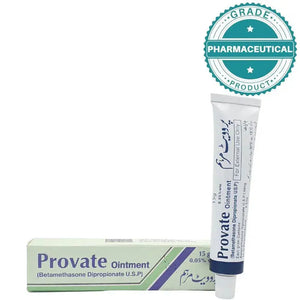
PROVATE OINTMENT (Betamethasone dipropionate U.S.P 0.05% w/w, by saffron Pharma)
Provate Cream & Ointment: Target severe psoriasis and dermatoses with inflammatory manifestations
Provate Cream & Ointment: Effectively treats psoriasis and dermatoses complicated by bacterial infections
Comprehensive Relief: Contains betamethasone, gentamicin, and salicylic acid for multifaceted treatment
Easy Application: Apply as directed for effective management, with some patients requiring less frequent use
Caution and Precautions: Careful use is advised to avoid side effects and complications, especially in children and during pregnancy

Pay in 3 Installments of
Rs.
41


Each gram of Provate Cream/Ointment contains:
Betamethasone
Dipropionate, Gentamicin Sulphate, Salicylic Acid
Provate Ointment is prescribed for the relief
of inflammatory manifestations of resistant or severe psoriasis and corticoidresponsive
dermatoses. ProvateG Cream/Ointment is specifically for those cases complicated
by secondary infections caused by Gentamicinsusceptible organisms. Conditions
treated include psoriasis, contact dermatitis, atopic dermatitis,
neurodermatitis, lichen planus, eczema, intertrigo, dyshidrosis, seborrheic
dermatitis, and more.
Ointment: Apply a
thin film to cover the affected area twice daily, morning and night. Some
patients may require less frequent application for maintenance therapy.
Lotion: Apply a few
drops of Provate/ProvateS lotion to the affected area and gently massage into
the skin or scalp twice daily, morning and night. Maintenance therapy may
require less frequent application for some patients
Avoid use if there is a history of sensitivity reactions to
betamethasone dipropionate, other corticosteroids, gentamicin sulphate,
salicylic acid, or any components of the formulation. Do not use in certain
skin conditions and infections
Use with caution during pregnancy and lactation. Weigh the
benefits against potential risks
Common side effects include mild to moderate burning,
stinging, dry skin, pruritus, and irritation. Other reactions, including with
corticosteroids, may occur, such as hypertrichosis, acneform eruptions,
hypopigmentation, and more. Gentamicin treatment may produce transient
irritation, and continuous salicylic acid use may cause dermatitis
Use as directed by a physician
Provate Ointment is available in a collapsible tube
containing 15g
Provate Cream, Ointment, and Lotion offer effective relief
for inflammatory skin conditions but require careful use and adherence to
guidelines for safe and effective treatment. Consult a healthcare professional
for proper evaluation and management
Apply a thin layer of Provate Ointment to the affected area twice daily, once in the morning and once at night. Gently massage the ointment into the skin until fully absorbed. For maintenance, your doctor may recommend applying it less frequently based on your specific condition.
Provate Ointment is prescribed for the treatment of inflammatory skin conditions, including psoriasis, atopic dermatitis, eczema, contact dermatitis, and more. It is particularly effective in cases complicated by secondary infections caused by Gentamicin-susceptible organisms.
Apply a thin layer of Provate Ointment to the affected area twice daily (morning and night). For some patients, less frequent application may suffice for maintenance therapy. Always follow your healthcare provider's instructions for best results.
Common side effects include mild to moderate burning, stinging, dry skin, itching (pruritus), and irritation. Rarely, side effects like hypertrichosis (excessive hair growth), acne-like eruptions, and hypopigmentation (skin lightening) may occur. Discontinue use if irritation or sensitization develops.
Provate Ointment should be used with caution during pregnancy and lactation. The benefits should be weighed against potential risks. Always consult your doctor before using this ointment if you are pregnant or breastfeeding.
Avoid using Provate Ointment if you have a history of hypersensitivity to Betamethasone Dipropionate, Gentamicin Sulphate, Salicylic Acid, or any other components of the formulation. It should also be avoided in cases of viral skin infections or certain skin conditions like acne rosacea.


