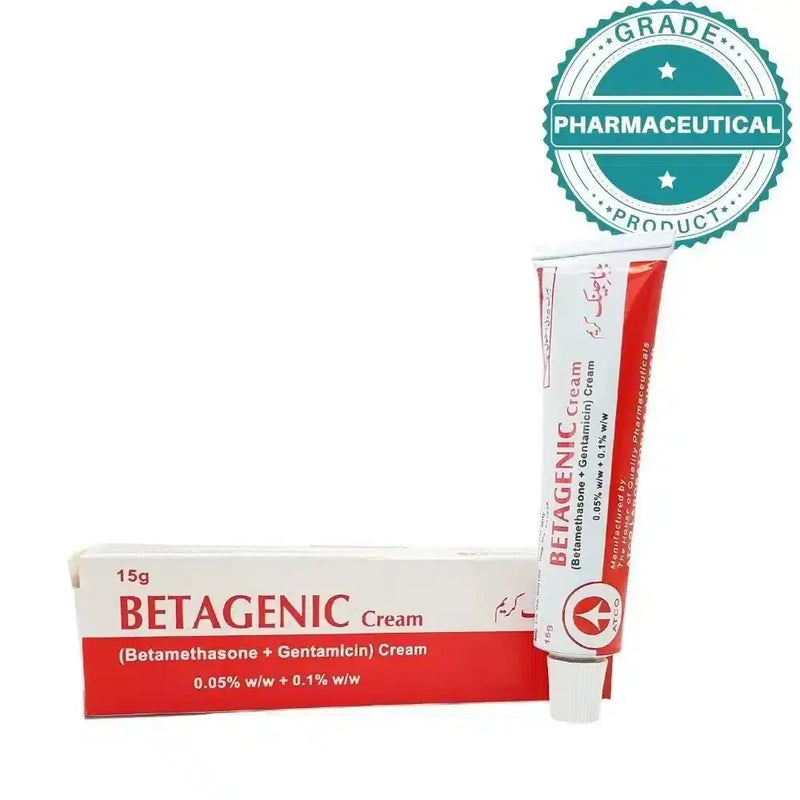
Betagenic Cream 15g

Pay in 3 Installments of
Rs.
42


 JazzCash
 easypaisa
 NayaPay


 Bank transfer
Cash on Delivery
Bank transfer
Cash on Delivery
Description
Description
Betagenic Cream is a combination of Betamethasone Dipropionate (0.05% w/w) and Gentamicin Sulphate (0.1% w/w), designed to address a wide range of skin conditions. It combines the anti-inflammatory and antipruritic properties of Betamethasone with the potent antibacterial action of Gentamicin, making it effective against both inflammation and secondary infections.
This cream is particularly useful for treating corticosteroid-responsive dermatoses such as psoriasis, eczema, dermatitis, and other skin conditions complicated by bacterial infections. Betagenic Cream effectively reduces itching, redness, and swelling while targeting harmful skin bacteria like Staphylococcus and Streptococcus strains.
Key Uses:
- Treats psoriasis, contact dermatitis, and atopic dermatitis.
- Effective for eczema, seborrheic dermatitis, and lichen planus.
- Manages stasis dermatitis, neurodermatitis, and dyshidrosis.
- Suitable for skin conditions with secondary bacterial infections.
How to Use:
- Apply a thin layer to the affected area twice daily or as directed by your physician.
- Gently rub until fully absorbed.
- For maintenance, some individuals may require less frequent application.
- Avoid applying to open wounds or sensitive areas like the eyes.
Precautions:
- Avoid prolonged use or excessive application, especially on large areas of skin.
- Discontinue use if irritation, redness, or itching occurs.
- Not recommended for children under 2 years old.
- Use cautiously during pregnancy or breastfeeding under medical supervision.
Possible Side Effects:
- Mild irritation, itching, or redness at the application site.
- Overgrowth of nonsusceptible organisms (like fungi) with prolonged use.
- Rarely, symptoms of overdosage such as adrenal suppression may occur.
Betagenic Cream is an essential solution for managing complex skin conditions while preventing secondary bacterial infections. For personalized recommendations, consult your physician before use.
Usage & Benefits
- Betamethasone Dipropionate 0.05%: potent corticosteroid that rapidly reduces inflammation, redness, and itching
- Gentamicin Sulphate 0.1%: aminoglycoside antibiotic effective against Staphylococcus and Streptococcus skin bacteria
- Treats psoriasis, atopic dermatitis, contact dermatitis, and seborrhoeic dermatitis
- Effective for eczema, stasis dermatitis, neurodermatitis, dyshidrosis, and lichen planus
- Controls secondary bacterial infections in inflamed or broken skin
- Reduces itching, redness, and swelling associated with corticosteroid-responsive dermatoses
- Twice-daily application for sustained relief
- Clinically established combination used by dermatologists across Pakistan
How To Use
- Apply as directed by your dermatologist. Do not self-medicate. Use for the prescribed duration only. General guidance (subject to physician instruction):
- Clean and gently dry the affected area before application
- Apply a thin layer to the affected skin twice daily, or as directed by your physician
- Gently rub until fully absorbed
- Maintenance therapy may require less frequent application as directed
- Avoid applying to open wounds, eyes, or mucous membranes
- Wash hands before and after each application
- Warning: Prolonged or excessive use of Betamethasone Dipropionate can cause skin thinning (atrophy), stretch marks (striae), and systemic absorption. Avoid use on large body surface areas for extended periods
- Not recommended for children under 2 years without medical supervision
- Store below 30°C, away from direct sunlight. Keep out of reach of children.
FAQs
Is Betagenic Cream available without a prescription?
No. Betagenic Cream contains Betamethasone Dipropionate (a potent corticosteroid) and Gentamicin Sulphate (an antibiotic). It is a prescription-only (Rx) medicine requiring a valid prescription from a registered medical practitioner.
What skin conditions does Betagenic Cream treat?
Betagenic Cream is indicated for corticosteroid-responsive dermatoses including psoriasis, atopic dermatitis, contact dermatitis, seborrhoeic dermatitis, eczema, stasis dermatitis, neurodermatitis, dyshidrosis, and lichen planus — particularly where secondary bacterial infection is present or suspected.
What bacteria does Gentamicin Sulphate target?
Gentamicin Sulphate is effective against a wide range of gram-positive and gram-negative bacteria, including Staphylococcus aureus and Streptococcus species, which are the most common causes of secondary skin infections.
Can prolonged use of Betagenic Cream cause skin thinning?
Yes. The Betamethasone Dipropionate component is a potent corticosteroid. Prolonged or excessive use can cause skin atrophy (thinning), stretch marks, and in rare cases adrenal suppression. Always use for the duration prescribed by your dermatologist only.
Is Betagenic Cream safe during pregnancy?
Use during pregnancy or breastfeeding should only occur under strict medical supervision. Inform your dermatologist if you are pregnant or breastfeeding before starting treatment.
Where can I find more corticosteroid cream options?
Browse our [Betamethasone Dipropionate collection](/collections/betamethasone-dipropionate), [Eczema & Dryness products](/collections/eczema-dryness), or [Psoriasis Care](/collections/psoriasis-care) for more dermatologist-recommended options.